In our hyper-connected, fast-paced modern lives, our minds are constantly flooded with a relentless stream of notifications, deadlines, and digital noise. We rush from one task to the next, our attention fractured, leaving us feeling drained and disconnected. In this state of perpetual motion, finding a moment of genuine stillness can feel almost impossible.
Yet, if you step into the quiet courtyard of a Zen temple in Kyoto, such as the famous Ryoan-ji, you are immediately enveloped by a profound, arresting silence. Before you lies no water, no lush flowerbeds, and no towering trees. Instead, you see only a rectangular bed of raked white gravel and a few carefully positioned, moss-draped stones. This is Karesansui—the traditional Japanese dry landscape garden. It is a space designed not for sensory entertainment, but for deep contemplation.
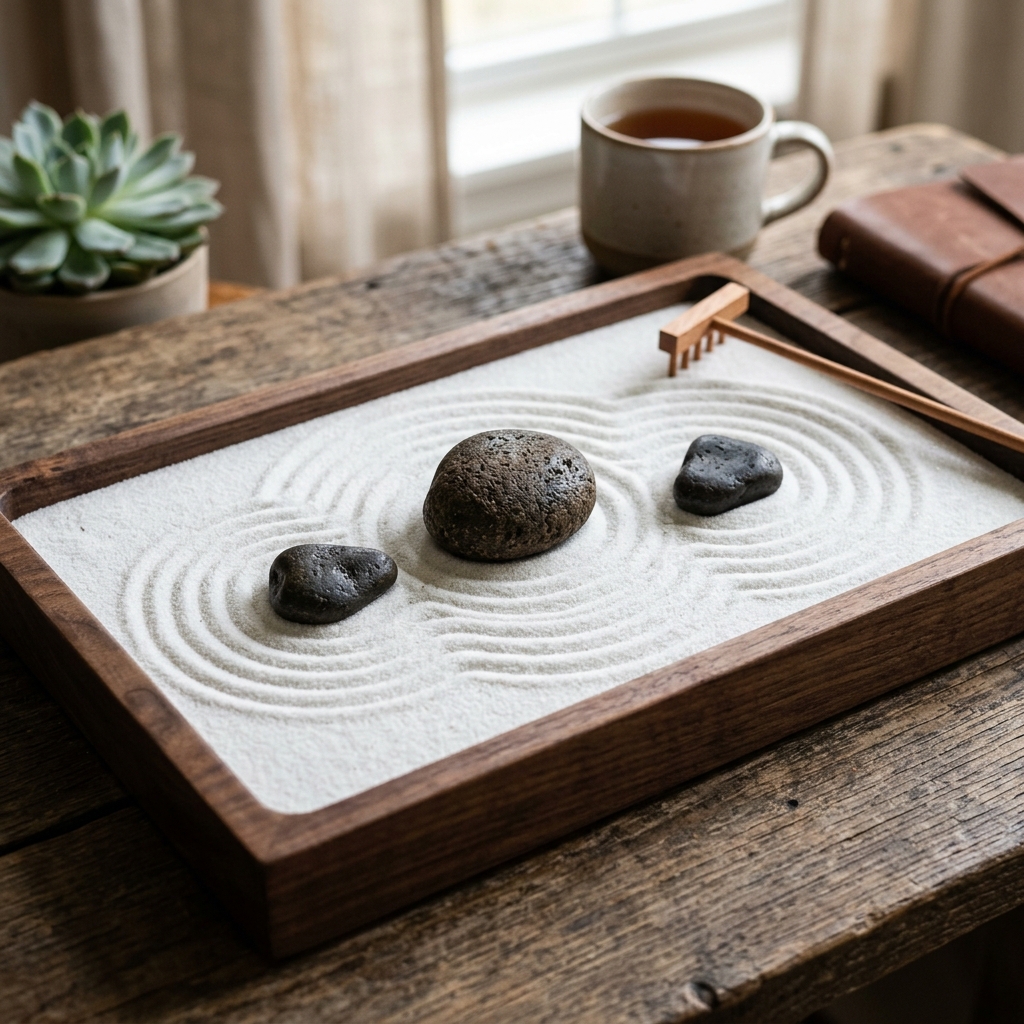
By bringing a miniature version of this ancient art into your home or workspace, you can create a desktop sanctuary. A mini Zen garden is not merely a decorative piece; it is a tangible invitation to slow down, breathe, and practice the art of mindful presence.
What is Karesansui? The Philosophy of Dry Landscapes
To appreciate the practice of a mini Zen garden, we must first understand the rich philosophical heritage of Karesansui (枯山水). Developed primarily during the Muromachi period (14th to 16th centuries) alongside the rise of Zen Buddhism in Japan, these gardens served as visual aids for monks seeking enlightenment. Lacking the resources or space for grand water features, Zen practitioners turned to the ultimate minimalist materials: stone and sand.
Two core concepts govern the spirit of Karesansui:
Mitate: The Art of Creative Seeing
Mitate (見立て) is the Japanese aesthetic concept of choosing to see one object as another—of finding the grand within the small, and the infinite within the finite. In a dry landscape garden, we do not see dry sand; instead, we see the gentle ripples of a calm ocean or the rushing torrents of a mountain stream. The stones are not merely rocks; they are ancient islands, sacred mountains rising above the clouds, or even a mother tiger guiding her cubs through the water. Through Mitate, the garden becomes a canvas for the imagination, allowing a tiny, enclosed courtyard—or a small wooden tray on your desk—to contain the entire universe.
Mu: The Power of Empty Space
In Western design, empty space is often viewed as something to be filled. In Zen philosophy, however, emptiness is known as Mu (無). Mu is not a cold void or a lack of existence; rather, it is a space pregnant with potential, a quiet pause that gives meaning to the elements around it. In Karesansui, the wide expanses of raked sand represent Mu. By leaving the sand open and uncluttered, the stones gain their power, and the viewer’s mind is given room to rest, breathe, and reflect.
The Active Meditation: Why Raking Sand Calms the Mind
For many of us, the traditional practice of Zazen (seated meditation) can feel intimidating. Sitting in absolute silence, trying to empty the mind of thoughts, often achieves the opposite effect: our brains begin to race, cataloging worries, tasks, and anxieties.
This is where a mini Zen garden offers a beautiful alternative: active meditation.
When you hold a small wooden rake and guide it through the sand, your mind naturally shifts its focus. The repetitive, rhythmic motion of drawing patterns—known as Samon (砂紋)—requires a gentle but precise coordination of hand, eye, and breath.
As you trace a line around a stone, your awareness narrows to the present moment: the texture of the sand resisting the wooden tines, the faint whispering sound of the grains shifting, and the smooth curve of the path you are creating. In this state of single-pointed concentration, the brain’s “default mode network”—the network responsible for daydreaming, self-criticism, and worrying about the past or future—quietens down. The simple act of raking becomes an anchor, pulling your drifting thoughts back to the safety of the present.
Creating Your Own Mini Zen Garden at Home
Setting up and interacting with a mini Zen garden is a deeply personal ritual. There are no rigid rules, only guidelines to help you cultivate a sense of inner harmony. Here is how to begin your practice.
1. Set Up Your Tray and Sand
Begin with a shallow tray, preferably made of a natural material like wood, stone, or ceramic. A rectangular or circular shape works best. Fill the tray about halfway with fine, clean white sand or very fine gravel. The white color of the sand reflects light beautifully and provides a clean, neutral slate, symbolizing the element of water and the openness of Mu.
2. Arrange Your Stones
Select a few natural stones that resonate with you. Look for stones with character—varied textures, weathered edges, and organic shapes. In keeping with the Zen aesthetic of Fukinsei (asymmetry), choose an odd number of stones, such as three or five, and avoid placing them in straight lines or symmetrical patterns.
As you place them, think of them as islands or mountains. Leave plenty of open space (Mu) around them. Let the stones “breathe.” The relationship between the stones and the empty sand is a reflection of the relationship between your thoughts and the quiet spaces in your mind.
3. Master the Art of Raking
Hold your mini rake lightly. There are several traditional patterns you can explore:
- Concentric Rings: Gently rake circles around your stones. This represents the ripples created when a stone is dropped into water, symbolizing the echoing impact of our actions and thoughts.
- Straight lines: Rake long, parallel lines across the length of the tray to represent a calm, flowing river or a peaceful, undisturbed mind.
- Wavy lines: Create gentle, winding curves to evoke the feeling of ocean waves or the shifting winds.
Don’t worry about making the lines perfectly straight or flawless. If the rake slips or a line wobbles, accept it as a reflection of life’s natural imperfections—a nod to the beauty of Wabi-Sabi.
4. Practice Mindful Presence
To make this a true mindfulness practice, establish a daily ritual.
- Disconnect: Step away from your computer and put your phone on silent. Dedicate just five to ten minutes of uninterrupted time.
- Coordinate Breath and Movement: As you draw a line with the rake, inhale slowly. As you lift the rake or turn, exhale. Let the physical movement sync with the rhythm of your breath.
- Embrace Impermanence: When you are finished, admire your creation for a moment. But remember, the sand is not permanent. The next time you sit down, you will rake over the patterns, smoothing the sand back into a blank canvas. This act of erasing the patterns is a practice of Mujo (impermanence)—a gentle reminder to let go of yesterday’s worries and start each day with a fresh, clear mind.
Conclusion: Finding Stillness in the Sand
A mini Zen garden is far more than a miniature replica of Japanese landscaping. It is a mirror for the mind.
When the sand is chaotic and messy, it reflects a cluttered, distracted consciousness. But as you slowly guide the rake through the white grains, smoothing out the rough patches and drawing steady, harmonious ripples around the stones, you will find that the noise in your head begins to quiet down.
You do not need to travel to a mountain monastery or sit in silence for hours to experience Zen. Sometimes, all it takes is a small wooden tray, a handful of sand, a few silent stones, and the willingness to be fully present. In the quiet waves of the sand, may you find the space to breathe, the clarity to see, and the stillness of a quiet mind.

Comments